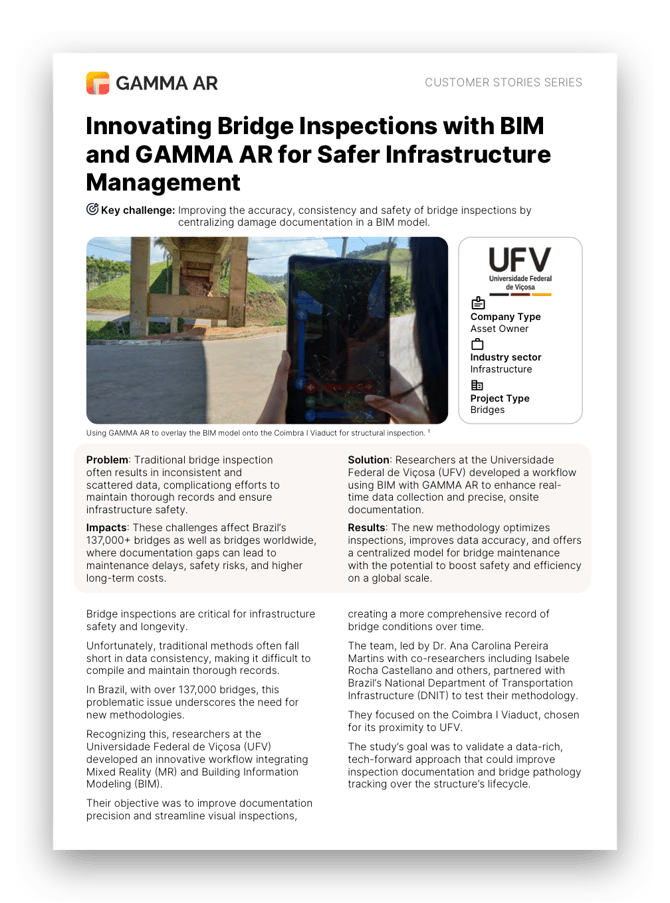
Al-Fanar: When VDC has the Field's Back
Al-Fanar is delivering the 73,000 m², eleven-building Jazan Entertainment Complex for Saudi Entertainment Ventures under concurrent design and construction, with 210 models updated bi-weekly and constant shop-drawing churn reaching the field. GAMMA AR put the current federated model in the hands of foremen and crews so clashes, sequencing errors, and design deviations were caught before they became rework, an estimated 20% reduction in site issues, backed by a disciplined rollout of written guides and monthly training.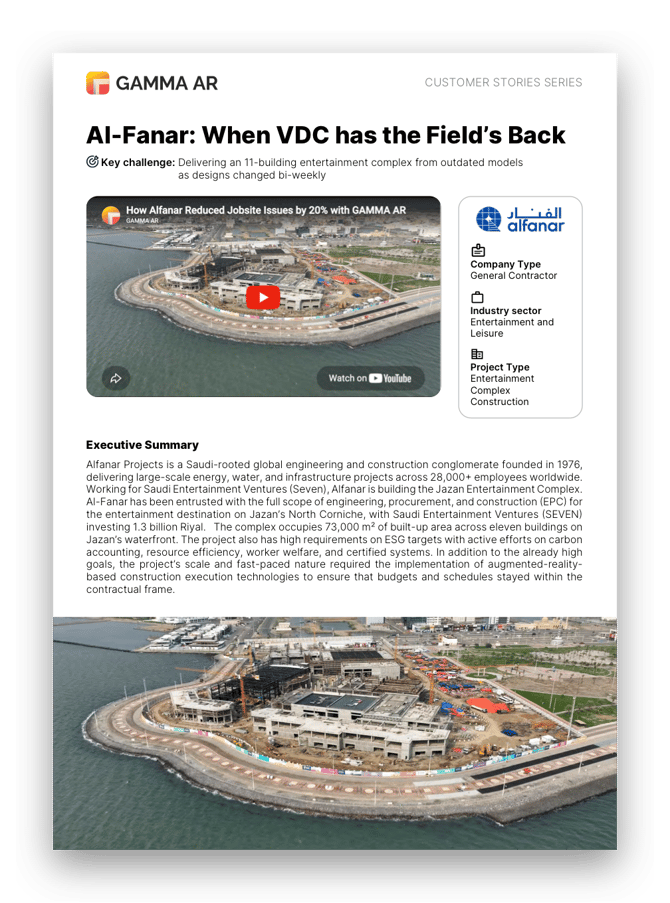
Dura Vermeer Bouw en Vastgoed Amsterdam: Revitalizing an Amsterdam Icon with Augmented Reality
On the OKU Office and OKU House development, Dura Vermeer combined the renovation of a protected historical monument with two new towers of 324 apartments, where undocumented past changes and concealed elements could surface at any moment. Field teams compared the BIM model against reality during daily walkdowns, catching things like a missing floor opening before concrete was poured, and the pilot's success led to rollout across multiple Dura Vermeer projects and departments.
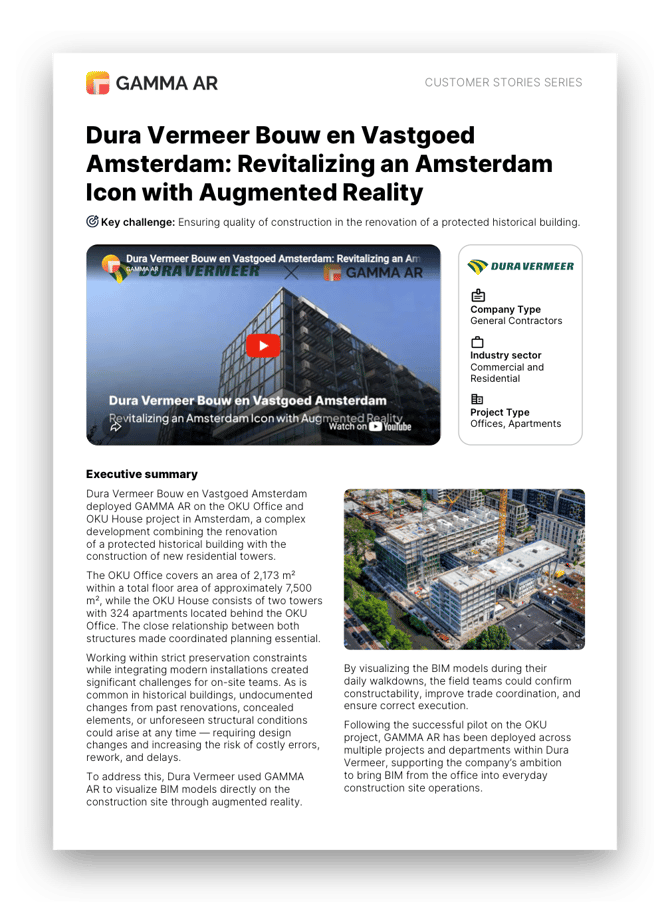
Batson Cook Streamlines Hospital MEP Coordination with AR Technology
On the Northside Hospital Gwinnett project, Batson Cook had to install patient lift systems across ten level-two patient rooms where required ceiling clearances collided with existing gravity pipes, HVAC, and pressure piping, conflicts that 2D drawings couldn't communicate to the field. GAMMA AR overlaid the BIM model on real conditions using iPad LiDAR, resolving the clearance conflicts in all ten rooms and shifting the company from reactive problem-solving to using the tool from project inception.
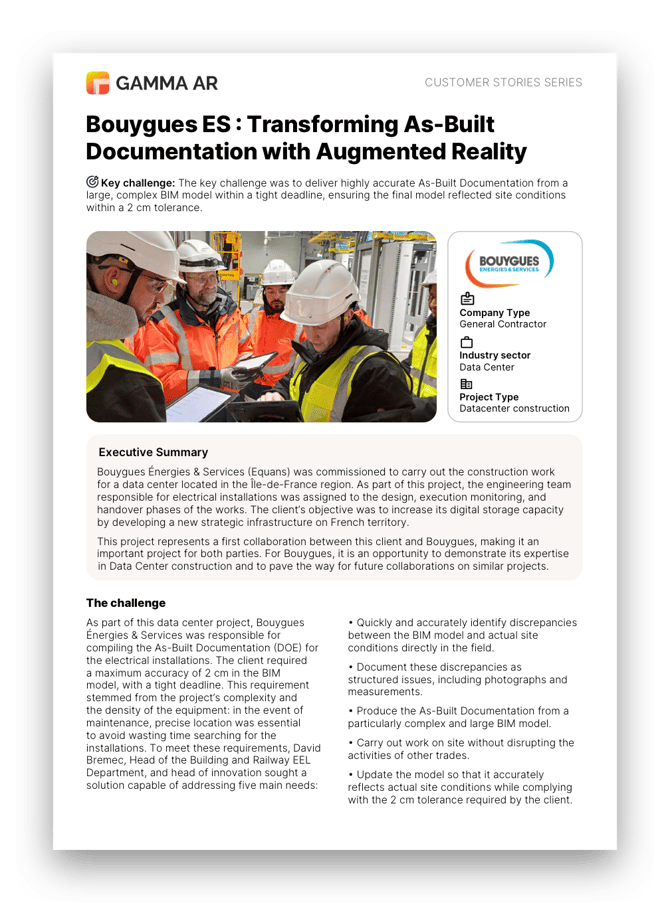
Bouygues ES : Transforming As-Built Documentation with Augmented Reality
Bouygues ES had to compile as-built documentation for the electrical installations of an Île-de-France data center from a large, dense BIM model on a tight deadline, where equipment density made discrepancies slow and risky to find by navigating the model in Revit. Pairing GAMMA AR for on-site discrepancy detection with 3D scanning for model updates, the team logged 608 documented issues in roughly 11 person-days and delivered the DOE in full, accepted without comment.
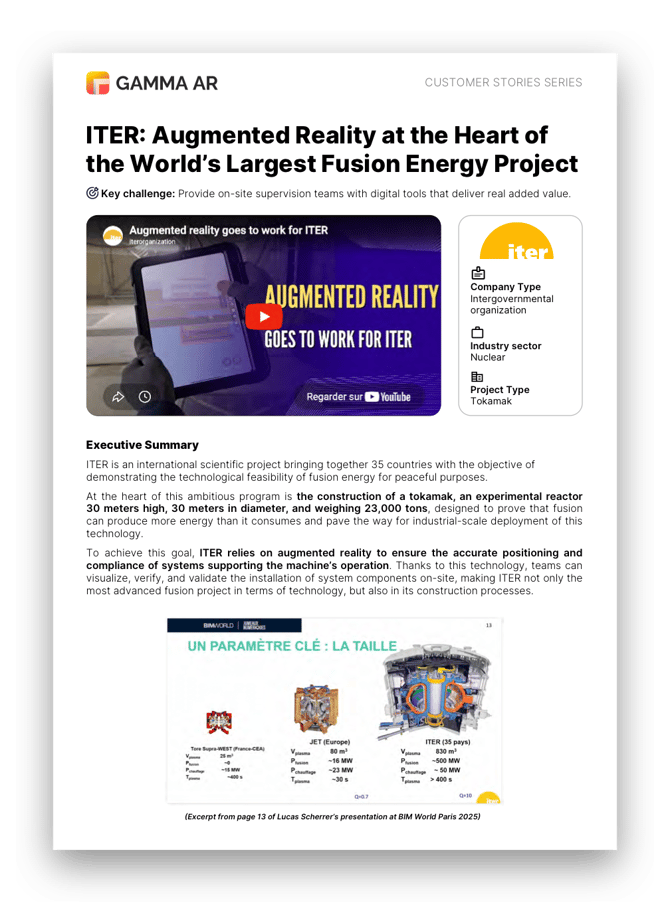
ITER: Augmented Reality at the Heart of the World's Largest Fusion Energy Project
The €25 billion, 35-country ITER project is assembling a tokamak 30 m high and 23,000 tons, and early non-conformities, including dimensional deviations at vacuum chamber interfaces and corrosion in the thermal shield cooling circuit, made it critical to catch deviations before they compounded. Supervisors now carry the reference model on IT-configured iPad Pros, working offline where there's no Wi-Fi and syncing issues bidirectionally with Autodesk Construction Cloud, replacing a paper-and-2D workflow that scattered notes, printed slides, and phone photos across the team.
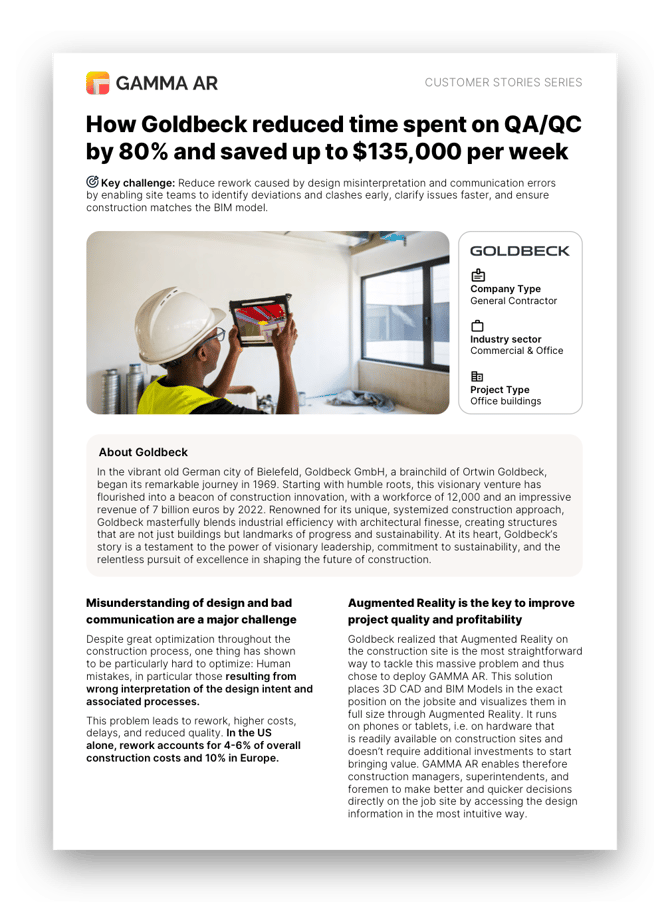
How Goldbeck reduced time spent on QA/QC by 80% and saved up to $135,000 per week
Goldbeck, a 12,000-person German contractor built on systemized construction, found that human error from misread design intent was the one inefficiency its process optimization couldn't touch, the kind of rework that runs 10% of construction costs in Europe. Across six test projects the site teams reported 80% less time spent on QA/QC, 79% faster clash detection on site, and 75% better design comprehension, amounting to roughly $1,500 saved per jobsite per week, or about $135,000 weekly across 90 jobsites.
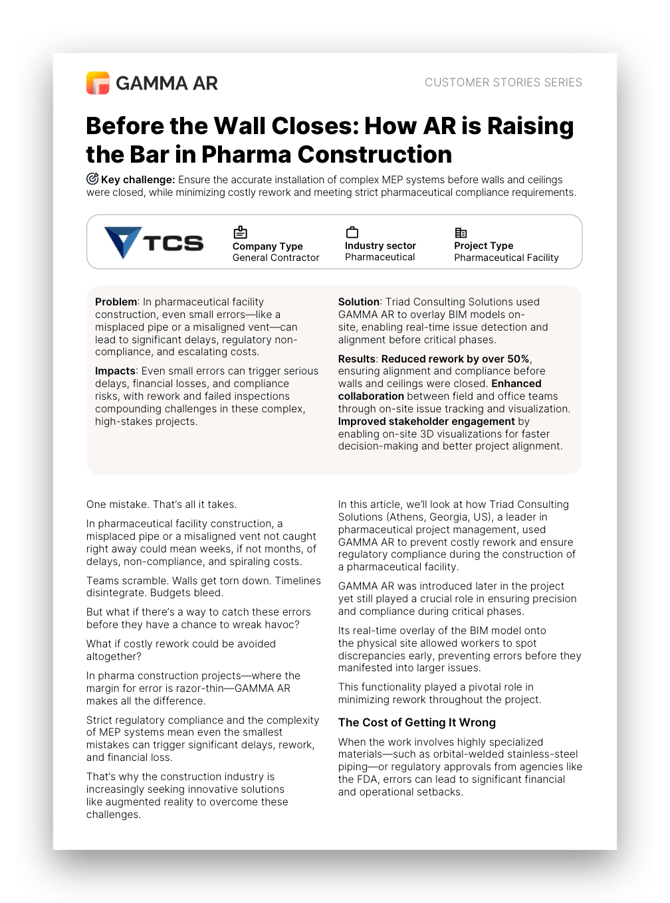
TCS: Before the Wall Closes: How AR is Raising the Bar in Pharma Construction
In pharmaceutical construction, a misplaced pipe or drain caught after walls close means torn-out drywall, new specialized materials, failed inspections, and regulatory exposure, and Triad Consulting Solutions brought GAMMA AR in once the steel was already up and the project had reached exactly that critical phase. Overlaying the model on the site let the team verify outlets, drains, and data drops before closures and generate documentation for regulatory proof, cutting rework by over 50%.
UFV: Innovating Bridge Inspections with BIM and GAMMA AR for Safer Infrastructure Management
Traditional bridge inspection scatters data across forms, reports, and photos, a documentation gap that matters across Brazil's 137,000+ bridges; UFV researchers, working with the national transport infrastructure department DNIT, built a BIM-plus-mixed-reality workflow and validated it on the Coimbra I Viaduct. Inspectors documented cracks and concrete spalling directly onto the model on site, reaching difficult and elevated areas visually rather than physically, and a second inspection confirmed the recorded data, turning the BIM model into a lasting repository of the bridge's condition history.